





















































































































































































































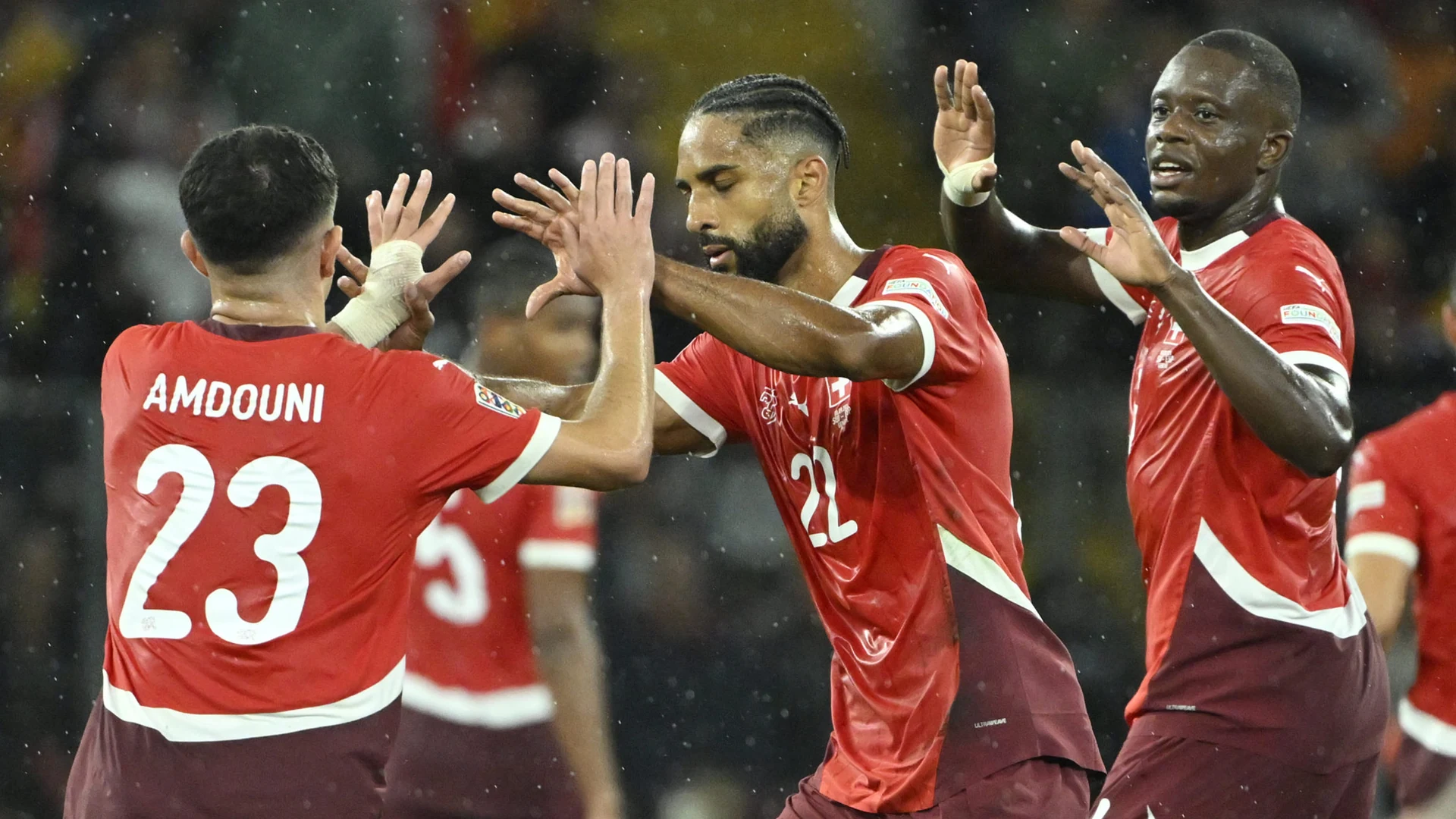
Switzerland opened their Nations League campaign with a 3-0 away victory over North Macedonia. Remo Freuler and Zeki Amdouni established the lead before half-time, and Amdouni added his second goal after the interval. The result came from control in both penalty areas rather than a late collapse by the hosts.
Switzerland turned possession into chances
The visitors did not treat control of the ball as an end in itself. Their midfield moved the point of attack until a runner could receive facing the North Macedonian penalty area. Freuler’s opening goal was important because it converted territorial control into an advantage and stopped the hosts from waiting indefinitely for one counterattack.
An away side can become vulnerable when both full-backs move at the same time. Switzerland limited that risk by keeping support behind the attack and recovering the second ball. North Macedonia were therefore asked to build their escape with more than one pass, which gave the Swiss midfield time to close the route.
Amdouni attacked the decisive spaces
Zeki Amdouni scored before and after half-time. His two goals were valuable not simply because of the total, but because they changed different stages of the match. The first widened the lead before the interval. The second removed the possibility that one North Macedonian goal would immediately turn the closing phase into a contest.
A forward in this type of match must remain available while the team circulates the ball outside the area. Dropping too deep can leave no target for the final pass, while staying fixed between two defenders makes movement easy to track. Amdouni found the balance and arrived where Switzerland’s possession needed a finish.
North Macedonia could not build sustained pressure
The hosts still had moments to move forward, but isolated attacks did not become a long period around the Swiss box. A short passing move out of defence is useful only when the final receiver has support. Too often the next option was behind the ball or too far away, allowing Switzerland to reset the defensive line.
Adding more attacking players would not solve the problem by itself. North Macedonia need better distances between the first passing option, the wide runner and the supporting midfielder. When those distances are short enough, a defensive clearance can become controlled possession. When they are stretched, one player is forced to beat several opponents before support arrives.
Switzerland also prevented North Macedonia from scoring
A 3-0 away win requires concentration after the attacking work has created comfort. Switzerland did not allow the score to loosen their defensive assignments or invite repeated crosses. The defenders continued to protect the central route and made North Macedonia take less dangerous shots from the outside.
Not conceding also helped the substitutes join a team that kept its shape. A replacement can follow a clear task when the structure remains intact. If the leaders begin chasing an unnecessary fourth goal, the final minutes can become disorganised. Switzerland kept the match connected to the original plan and carried the advantage to full time.
Both teams leave with clear priorities
Switzerland leave the first round with three goals, no goals conceded and an early reference for their attacking structure. The next test is whether the same patience works against an opponent that presses higher and denies time in midfield. Amdouni’s movement can still help, but the route into him may have to change.
North Macedonia need a response that preserves defensive discipline while improving the first pass after regaining possession. The 3-0 score is clear, yet it does not require a complete reinvention. A nearby passing option and better control of the space in front of the centre-backs would address the two phases that Switzerland exploited most consistently. North Macedonia’s post-match analysis should begin with the space in front of the centre-backs. Switzerland repeatedly placed one player between the lines and another beyond him, forcing a defender to choose between stepping out and protecting depth. Amdouni benefited from those decisions rather than waiting as an isolated striker. The hosts can improve without abandoning their attacking plan: the nearest midfielder must close the player receiving the first pass, while the far-side defender moves inside to protect the next pass. That adjustment would also shorten the distance to a loose ball and give the full-backs a clearer signal about when they can press. It is a compact correction, not a demand to rebuild the entire shape.

Comments
No comments yet — be the first to share your thoughts.