

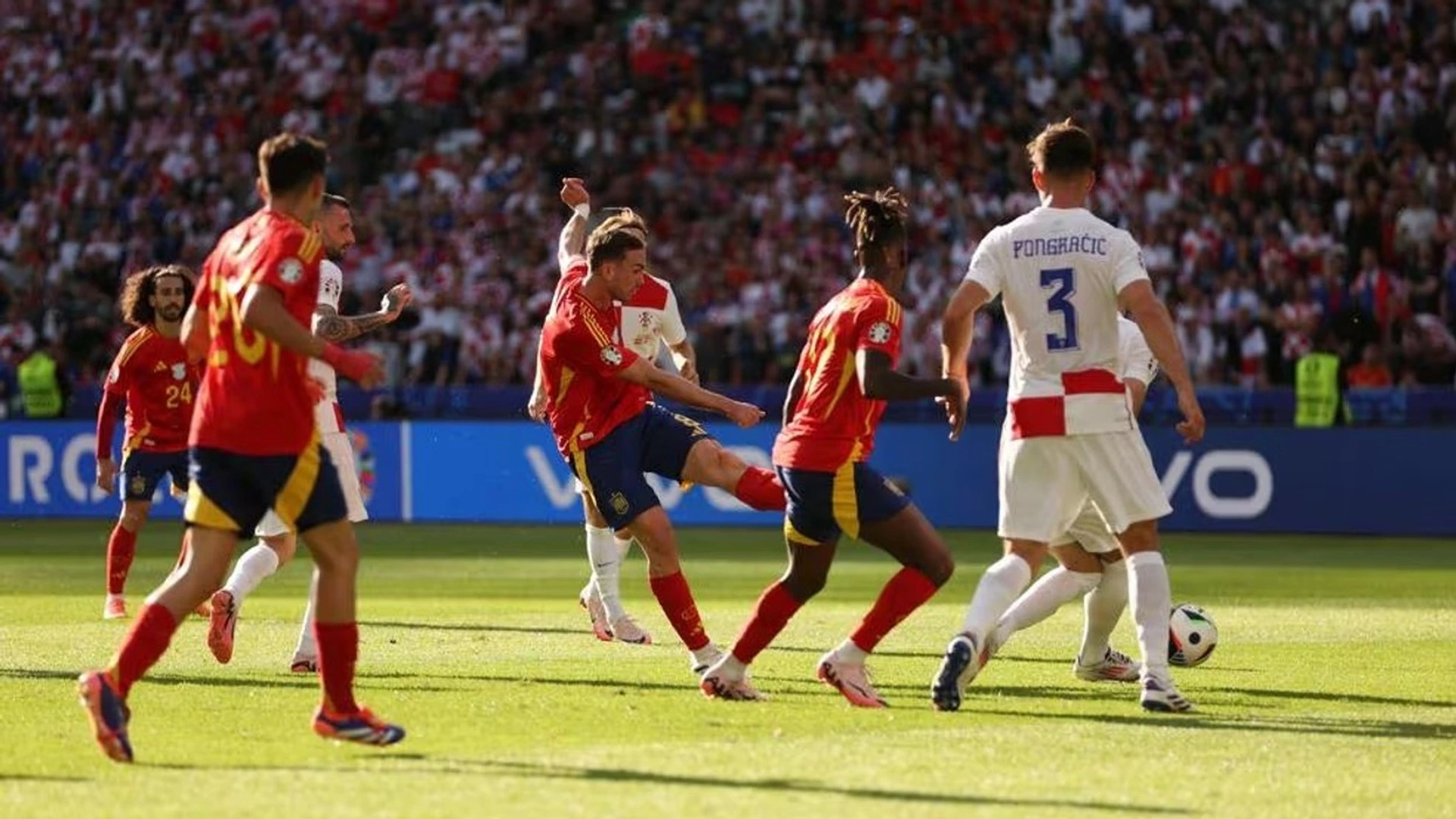
Spain have opened their Nations League campaign with consecutive victories after a 4-1 home win over Croatia. The result follows the 3-2 success away to England and leaves Spain with seven goals from two Group A3 matches. Croatia arrived with three points from Czechia, but the second fixture exposed the cost of defending for long periods without keeping a secure route out of pressure.
Spain made possession serve the next action
Long spells on the ball matter only when they move the defense or prepare a decisive pass. Spain’s attacking structure is most dangerous when one player fixes the wide defender, an inside option occupies the half-space and a deeper teammate protects the return pass. The ball can then travel forward, back and across without leaving the team exposed after one blocked attempt.
Against Croatia, the four-goal return shows that control reached the scoring areas. The useful lesson is not to force the first opening. Repeated circulation changes the angle from which a runner is tracked, and a late movement can become free because the defender has already adjusted several times. Patience works when it has direction and supporting positions.
Croatia needed a cleaner escape from the first line
A compact block can protect central space, but it also places many players behind the ball. When possession is regained, the first receiver may have no forward option within a safe distance. If that player clears blindly, Spain can begin again before Croatia have moved out. The defense then performs another long sequence with less energy than the previous one.
One solution is a deliberately prepared outlet on the far side. The receiver does not need to attack immediately; securing one pass away from pressure can draw Spain’s rest defense across and create room for the next connection. Croatia’s goal shows they could reach the scoring line, but a single successful attack was not enough to change the overall territorial pattern.
Four different moments still require defensive balance
A 4-1 score can encourage every player to join the next attack, yet Spain’s control depends on the people who remain behind the ball. Their spacing has to cover a direct pass and the second ball while allowing the nearest midfielder to counter-press. That preparation is what turns a lost attack into another period of pressure instead of an open sprint toward the opposite goal.
The wider the attacking shape becomes, the more important the central protection. Full-backs and wingers can stretch Croatia, but the central defenders should not be asked to defend the whole width alone. Spain’s best periods combine freedom near the box with strict responsibility behind it. The scoreline rewards the visible part, while the structure underneath keeps it possible.
| Spain campaign marker | After two matches |
|---|---|
| Results | 3-2 away to England; 4-1 at home to Croatia |
| Goals scored | 7 |
| Goals conceded | 3 |
| Points | 6 |
| Group | UEFA Nations League A3 |
Croatia’s experience could not replace fresh distances
Experienced midfielders can recognize pressure and choose the correct pass, but recognition is useful only if a teammate arrives at the right distance. Too close, and one Spanish defender can pressure both. Too far, and the pass becomes slow or risky. Croatia needed compact support around the first receiver before trying to access the attacking line.
That does not mean placing everyone in the same central pocket. A staggered triangle offers a short pass, a return and a forward option. Once Spain commit to one side, the opposite runner can attack the space they leave. The 4-1 defeat should be reviewed through those distances rather than reduced to a general complaint about possession.
Spain’s second win changes the group’s pressure
Six points from two matches give Spain room that their rivals do not have. England’s win in Czechia keeps the chase active, while Croatia and Czechia now need their next results to prevent an early gap from becoming structural. Goal difference also matters in a compact league phase, and scoring four adds value beyond the immediate victory.
The advantage does not remove the need to manage the next window. Opponents will now have two full matches of evidence about Spain’s buildup, pressing triggers and preferred final-third combinations. The leader’s task is to preserve the principles while changing the route. Predictable control can still be defended if every attack reaches the same player in the same location.
Croatia must protect confidence without ignoring the margin
A heavy away loss can produce an emotional overcorrection: press higher, play faster and change several roles at once. The more useful response is to identify which failures repeated. If the first outlet disappeared, train that pattern. If wide defenders were isolated, adjust the cover. Specific repairs keep the team recognizable while addressing the reasons the match escaped.
Croatia already showed in the opening win that they can compete in this group. Spain showed that the next level of pressure punishes every disconnected phase. The goal is not to imitate Spain’s possession but to ensure Croatia’s own recovery, support and progression operate as one sequence rather than three separate events.


Comments
No comments yet — be the first to share your thoughts.